Monday, March 17, 2014

Lance Henriksen vs. Stephen McHattie: Can you tell them apart?

Played the cop who drives bankrobbers Sonny and Sal to the airport in Dog Day Afternoon (1975) Answer
Played Hollis Mason — the former superhero known as Nite Owl — in Zack Snyder's Watchmen (2009) Answer
Played the leader of a gang of vampires in Near Dark (1987) Answer
Appeared in the Jim Jarmusch western Dead Man (1995) Answer
Met his end in Viggo Mortensen's diner in A History of Violence (2005) Answer
Witnessed the unloading of an alien spaceship in Close Encounters of the Third Kind (1977) Answer
Appeared in the 2009 disaster film 2012 Answer
Appeared in 1975's The Ultimate Warrior, starring Yul Brynner, which took place in 2012 Answer
Played a Spartan politician in the 2006 film 300, which took place in 480 BC Answer
Played the android Bishop in Aliens (1986) Answer
Appeared in the Charlton Heston submarine film Gray Lady Down (1978) Answer

Monday, February 10, 2014

Winter games, Bond-style

The Winter Olympics always make me want to watch James Bond, probably because Bond himself has always had an affinity for winter sports. While the athletes at Sochi face the true dangers inherent to such competition, Bond's winter games entail more outlandish challenges. Here's a look at some of 007's best events.

Skiing

For Bond, skiing includes threats even more sinister than a biased Olympic judge. The danger could be in the form of gunmen on skis . . .

On Her Majesty's Secret Service (1969)

The Spy Who Loved Me (1977)

. . . gunmen shooting from the villain's lair . . .

On Her Majesty's Secret Service (1969)

. . . gunmen on motorcycles . . .

For Your Eyes Only (1981)

. . . gunmen in snowmobile propeller parachute things . . .

The World Is Not Enough (1999)

. . . or an avalanche.

On Her Majesty's Secret Service (1969)

Bond doesn't always ski with traditional equipment; spiked tires and outrigger skids make even his Aston Martin suitable for the slopes.

The Living Daylights (1987)

Ski Jumping

Bond's ski runs sometimes include a jump motivated more by the need for escape than by the thrill of victory.

For Your Eyes Only (1981)

Though a traditional hill is often passed over in favor of a cliff . . .

The World Is Not Enough (1999)

. . . a helicopter . . .

The World Is Not Enough (1999)

. . . a roof . . .

For Your Eyes Only (1981)

. . . or a picnic table . . .

For Your Eyes Only (1981)

Some jumps require special equipment . . .

The Spy Who Loved Me (1977)

. . . and all look better with explosions.

The World Is Not Enough (1999)

Snowboarding

You know, while being shot at by gunmen on skis.

A View to a Kill (1985)

Ice Skating

Skating makes Bond nervous, especially when he needs to fend off an awkward infatuation.

For Your Eyes Only (1981)

Hockey

Bond's hockey is a contact sport with badly unbalanced teams.

For Your Eyes Only (1981)

Bobsledding

A sled is not always required. Chasing a sled while on skis still gets points, provided Bond is himself being chased by a henchman on a motorbike.

For Your Eyes Only (1981)

Sleds can also be improvised, as from a cello case.

The Living Daylights (1987)

An actual bobsled is preferable, however, because it offers more room for grappling with archenemy Blofeld.

On Her Majesty's Secret Service (1969)

See also: Bonding Ritual

Tuesday, September 17, 2013

This is not an apple

Citizen Kane (1941)

Someone once complained to me that Orson Welles wasn't as great as his reputation, citing the shot of the eyeless cockatoo from Citizen Kane — whose transparent eye was apparently an unintended effect of the imposition process — as evidence that Welles received praise for such accidents as if they were intentional and meaningful moments of his own design. The cockatoo shot is ripe for such debate between people who may wonder what the bird's transparent eye signifies and those who would dismiss any such search for "meaning" due to the effect's unintentional origin. Filmmaker and Welles confidant Peter Bogdanovich, on a commentary track on the Citizen Kane DVD, explains that Welles told him the shot was only inserted to reclaim the audience's potentially waning attention at a late point in the film. Accepting anything Welles said about his own work at face value is risky, but refusing to allow that the shot could have any effect beyond Welles' own imagining is more so.

In a 2013 blog post about Room 237, a documentary in which fans of The Shining explain their theories about the Kubrick film, David Bordwell, addressing one theory that The Shining is Kubrick's apology for helping fake the Apollo 11 landing, wrote:

The Apollo 11 argument illustrates the risk of appeals to intention: they tend to substitute causal explanations for functional ones. That is, they tend to look for how something got into the film rather than what it's doing in the film. But that's a risk that professional critics run as well when they appeal to intention. The problem is just more apparent when the causal story that's put forward seems tenuous.


While the technical explanation of the transparent bird eye is perhaps easier to accept than the claim about Kubrick and Apollo 11, the problem of "appeals to attention" is applicable to debate over the Kane shot as well. Regardless of how the transparent eye came to be, it nonetheless ended up in the final film, and can therefore influence the viewer's response. All meaning in a film — or in any work of art — rests with the viewer. Filmmakers can do their best to shape an intended meaning or effect, and they can explain their intentions forever after; still, for better or worse, meaning is in the mind of the beholder.

Ceci n'est pas une pomme
Rene Magritte, 1964
The Magritte painting Ceci n'est pas une pomme ("This is not an apple") demonstrates the disparity possible between an artist's intentions and the end effect on a viewer. At first, the discrepancy between what the painting depicts (an apple) seems to be at odds with the inscription above it ("This is not an apple"). By one interpretation, this can be resolved by realizing that the apple is merely a depiction of an apple; thus, "this is not an apple." But there is something more at work. Magritte has included above a very recognizable image of an apple an equally unambiguous statement, "This is not an apple." In doing so, he has given us conflicting information about what we see and what we are told. Specifically, between what he is showing us and what he is telling us. To resolve this intellectual conflict, we must decide for ourselves what we are looking at. Thus, the painting is also a demonstration of the audience's relationship to the artist -- more precisely, of the relationship between the artist's intentions and the audience's perception.

What if Magritte had inscribed something else, like "This apple is hanging from a tree" or "This apple has been poisoned"? Our decision would then be to decide if we accept this extra information about the apple, to determine if what the artist tells us about his own thoughts and intentions are relevant to our perception or "interpretation" of the apple. There would be nothing requiring us to accept such statements, and there is nothing requiring us to accept, or accept in a specific and predetermined way, the statement "This is not an apple." It is not incorrect for us to reject that statement in favor of what we believe we see, nor is it incorrect to reject a filmmaker's stated intentions in favor of what we interpret from the final film.*

I'll close with a few movie moments that came to mind when writing this.

Opening title card from Fargo

Fargo (1996)

I wouldn't necessarily fault anyone who accepted this statement without question, though claims such as this beg examination. When I first saw Fargo, I assumed this statement was false (it is a movie, after all) and wondered why it was included; what I accepted without question was that the Coen brothers thought it contributed somehow to the film. (For insight on this, see an interview snippet with Joel Coen in Karl Heitmueller's Rewind: What Part Of 'Based On' Don't You Understand?)

Jesus confronts Paul in The Last Temptation of Christ


When Jesus, saved from the cross and living a regular life, tells Paul that Paul's stories of Jesus' death are not true, Paul tells Jesus that the reality of Jesus' life does not matter to him when compared to what the people need to believe. If he, as storyteller, needs to interpret the details of Jesus' life in order to make his point, he will. (Hopefully, he's prepared for his audience to do the same and interpret his stories as they see fit.)

Marshall McLuhan stifles a know-it-all in Annie Hall


McLuhan appears in order to back up Alvy's assertion that a man in line knows nothing about McLuhan's work. Alvy wishes, "Boy, if life were only like this." Maybe to Allen the filmmaker, who could then assert more control over how his films were perceived, this is an appealing fantasy. Still, it would be impossible. Even if he inserted himself into all of his films in order to explain his intentions, or magically appeared in person at every screening of his movies, it wouldn't prevent viewers from thinking what they want. In fact, it would probably prompt more questions about what his explanations really mean.**


*I am using the Magritte painting in my own way for example. While I feel that this particular "reading" could be as valid as any, I admit that it depends upon splitting two equally important elements (the written phrase and the depiction of the apple) of a unified work (the painting "Ceci n'est pas une pomme") in order to demonstrate the relationship between two separate things. A director's intentions, and the discussion thereof, are external to a film, while Magritte's phrase and apple are both integral parts of a single work, one which appears to have been designed to prompt that very discussion.

**Certainly there is a difference between interpreting something and misunderstanding it, and in this scene it appears that the man in line is doing the latter. Academic work like McLuhan's is less open to interpretation than artistic work, and there are elements of filmmaking that are more closed to interpretation than others (we know what shot/reverse-shot signifies, for example, or what is implied by a blurry "coming-to" shot). So while it would be difficult to argue that the temporal discontinuity of Citizen Kane indicates something other than flashbacks, e.g., less codified elements like the cockatoo shot are more open to interpretation.

Thursday, June 27, 2013

A Hitchcock tour of U.S. landmarks

Saboteur (1942)

Hoover Dam (Boulder Dam), Nevada

Empire State Building and New York City skyline

Statue of Liberty, New York

Strangers on a Train (1951)

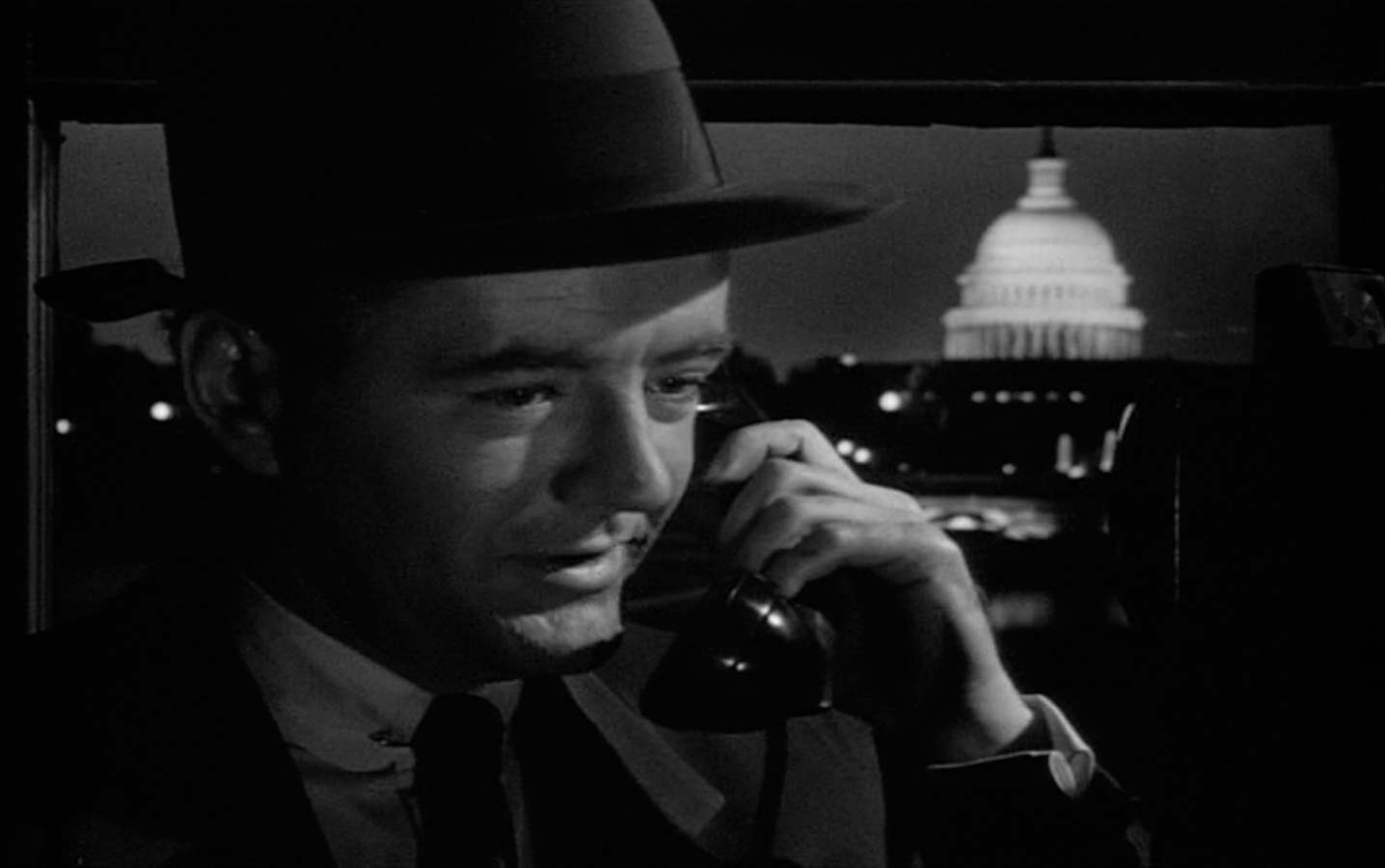
U.S. Capitol, Washington, D.C.

Jefferson Memorial and Washington Monument, Washington, D.C.

National Gallery, Washington, D.C.

Vertigo (1958)

Golden Gate Bridge, San Francisco

Redwood forest, California

North by Northwest (1959)

United Nations Headquarters, New York

U.S. Capitol, Washington, D.C.

Mount Rushmore, South Dakota

Tuesday, May 7, 2013

Ray Harryhausen (1920-2013)

Film Fantasy Scrapbook,
still on my shelf after 39 years
My oldest Ray Harryhausen memory is from second grade, when I took my father's copy of Harryhausen's Film Fantasy Scrapbook to school. My father was the TV critic for the local paper at the time; knowing this, and noticing the book on my desk, my teacher presumed my father to be an expert on special effects and asked him to give a presentation on the subject.

I was beyond excited to have my father in school on the day of the presentation, and I did not hesitate to leave my seat and wander to the front of the auditorium (the audience had increased somewhat from the time my father was asked to speak to the time of the actual presentation) to interrupt him for the sake of getting laughs and impressing my friends. ("Who are we, the Smothers Brothers?" I remember asking him in the middle of his explanation of stop motion photography. He replied that we were, but that I was to be Tommy, whose role it was to sit quietly while he, Dick, spoke. I'm not sure the Smothers Brothers followed that rule, but I know I didn't. My father was not amused.)

Years later, in seventh grade, I gave my own presentation during a "floor talk" in English class. I opened with a mention of Fay Wray and King Kong, tried demonstrating the stop motion technique using a model dinosaur I had almost completed, and concluded with a look at the same copy of Film Fantasy Scrapbook from third grade.

In the pre-VHS, pre-DVD days of my childhood I didn't see many of Harryhausen's movies, save for the few that were occasionally shown on UHF channels. I remained captivated, though, by Film Fantasy Scrapbook, by the monsters it depicted, and especially by the technique with which they were animated. I kept a lookout for stop motion effects in other movies — The Empire Strikes Back is a great memory of that — and was happy when Harryhausen returned to the screen with Clash of the Titans.

Eventually, as special effects evolved, I began to feel as if stop motion had reached its peak and levelled off. In discussions with friends, I would say that it had been perfected early on, meaning in Harryhausen's prime, and that it was as good as it would ever be, but that it was easily being eclipsed by modern techniques. I was skeptical of those who claimed otherwise, though I still remained fond of Harryhausen's work, which I began to collect avidly on DVD.

Then, recently, I watched the remake of Clash of the Titans (2010), and I quickly realized how much more effective Harryhausen's work on the original is compared to the computer effects of the remake. The digital monsters of the new film are nicely rendered, to be sure, but the action scenes into which they are inserted lack a grounding element — there is simply too much digital stuff filling the screen, tumbling beyond orientation, leaving the viewer lost in a flurry of pixelated scales, fur, claws, etc. Watching the original once more, I noticed how Harryhausen's creatures, while noticeably "artificial," nonetheless become part of the world inhabited by the human actors. The threat or benefit which they represent can be felt, because their relationship to the human characters feels more physical, more real.


So much has been said about the expressiveness of Harryhausen's characters and about his ability to "act" through them. Taking some screencaps for this post, I realized how valid this praise is. Watch the introduction of the troglodyte in Sinbad and the Eye of the Tiger (above), for example, and you will see as natural a progression from aggressiveness to fear to curiosity to acceptance as could be given by any talented actor — and it was done by a man working with miniature models one frame at a time. The fluidity of this scene belies the days, weeks, or months that went into making it, the time between each frame that was spent repositioning the puppet, the skill required to virtually stop time and reassemble it a fraction of a second at a time, somehow remaining aware of how one pose would lead to the next to create a seamless motion and a polished performance.

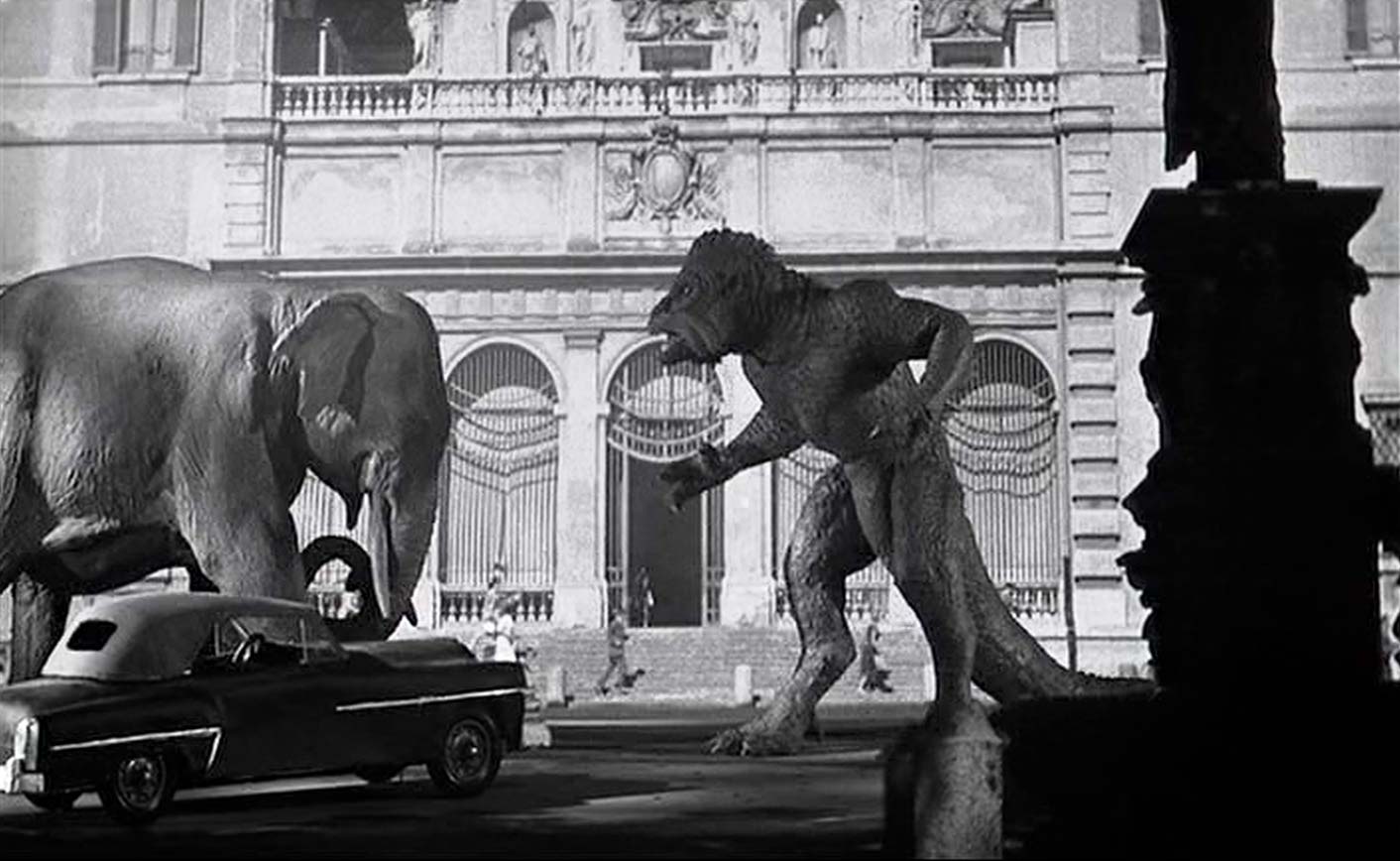
Below are frames from all of Harryhausen's feature films, I think, except for The Animal World. Also included are frames from two of his several short subjects, both based upon fairy tales. They are presented here in memory of the man, who died today at age 92.

Little Red Riding Hood (1949)
Mighty Joe Young (1949)
Hansel and Gretel (1951)
The Beast from 20,000 Fathoms (1953)
It Came from Beneath the Sea (1955)
Earth vs. the Flying Saucers (1956)
20 Million Miles to Earth (1957)
The 7th Voyage of Sinbad (1958)
The 3 Worlds of Gulliver (1960)
Mysterious Island (1961)
Jason and the Argonauts (1963)
First Men in the Moon (1964)
One Million Years B.C. (1966)
The Valley of Gwangi (1969)
The Golden Voyage of Sinbad (1973)
Sinbad and the Eye of the Tiger (1977)
Clash of the Titans (1981)