
Showing posts with label X-Men. Show all posts

Friday, August 5, 2011

Green lady down

Today's release of Rise of the Planet of the Apes brings remembrance of the 1968 original and its . . . monumental ending. Here's a look at several films in which the Statue of Liberty is destroyed, damaged, or otherwise dirtied.

Planet of the Apes (1968)


Rotted by age and chest-deep in sand, Lady Liberty triggers one of the most memorable revelations (and surprise endings) in all of science fiction when discovered on a beach by shipwrecked space explorer George Taylor.

Cloverfield (2008)


Terrified twentysomethings run for cover when the statue's head is bowled down a city street by a rampaging monster.

Independence Day (1996)


The statue is shown toppled the morning after extraterrestrial invaders destroy many of the world's cities.

X-Men (2000)


The superhero team takes on bad guy Magneto and punches holes in the famous landmark during a battle atop the statue's head and torch.

The Day After Tomorrow (2004)


Global warming brings about a new Ice Age which leaves the Statue of Liberty knee-deep in snow and ice.

Deep Impact (1998)


When a comet slams into Earth, the resultant tidal wave engulfs New York and washes the statue away; its head is later seen floating between newly submerged buildings.

Superman IV: The Quest for Peace (1987)


During a battle with Superman, the evil Nuclear Man tears the statue from its platform and drops it onto a crowded city street; luckily, Superman is close by to save the day — and the statue.

Superman III (1983)
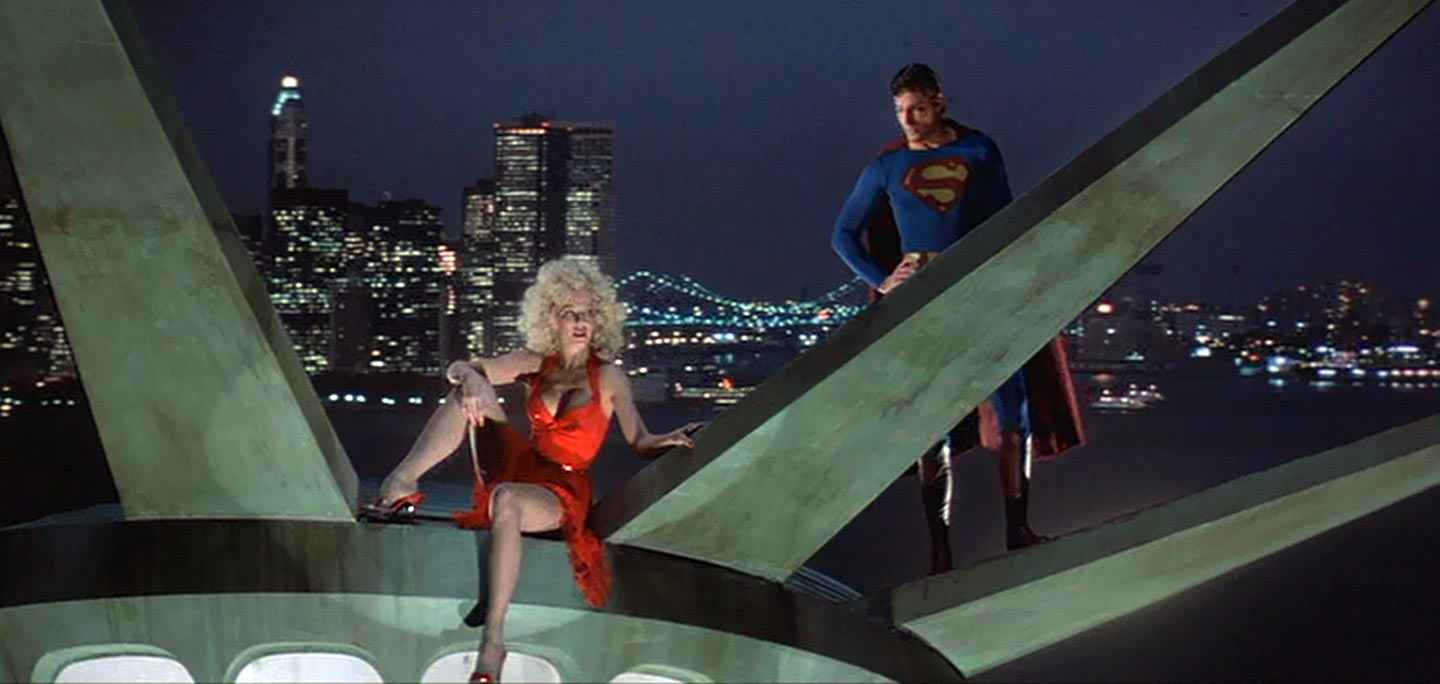

No real damage is done to the statue in this movie, although her crown is undoubtably sullied after a surly and cynical (not to mention dirty) Superman — under the influence of some bad Kryptonite — uses it as a platform (literally) to test pickup lines on the bad guy's girlfriend.

Spaceballs (1987)


The nefarious Dark Helmet's ship, transformed into the vacuum cleaner-wielding "Megamaid", crash-lands onto the beach of a nearby planet, setting up a Planet of the Apes joke complete with apes on horseback.

Friday, July 15, 2011

Homage, reference, and free association: Harry Potter edition

With today's release of the last Harry Potter movie, Second Reel presents a look at several memorable moments from the series and their counterparts from other films.

Harry Potter and the
Sorcerer's Stone
Star Wars:
A New Hope
Excalibur
On his eleventh birthday Harry is visited by Hagrid, a man from the magical world who tells Harry his parents were not Muggles who died in a car crash, but wizards who died fighting the Dark Lord Voldemort. Hagrid tells Harry that he, too, is to be educated as a wizard.

Luke Skywalker encounters the Jedi knight Obi-Wan Kenobi — described by Luke's uncle as a "wizard" — who tells Luke that his father was not a space navigator but a great warrior who died fighting a corrupt Jedi named Darth Vader; Obi-Wan invites Luke to accompany him on a rescue mission and to learn the ways of the Jedi.

After extricating the legendary sword Excalibur from a rock, young Arthur is confronted by the wizard Merlin, who tells him that his father was actually King Uther, and that Arthur, too, is destined to be king.
Harry Potter and the
Sorcerer's Stone
Clash of the Titans
(1981)
The Lord of the Rings:
The Two Towers
Harry is given a magical cloak that makes him invisible, much like the helmet bestowed by the gods upon Perseus. Frodo's cloak, given to him by elves, has the power to conceal by mimicking its surroundings, at one time looking like a rock in the presence of Sauron's minions.
Harry Potter and the
Chamber of Secrets
Clash of the Titans
(1981)
Harry must defeat the basilisk, a giant serpent whose stare petrifies anyone who looks it in the eye. Perseus must battle Medusa, a half-woman, half-serpent creature who can turn men to stone with her eyes and which, like the basilisk, can only be safely viewed in reflection. The heroes use severed parts of the creatures to save the lives of their future wives: Harry uses a basilisk fang to vanquish the fragment of Voldemort's soul that threatens to kill Ginny, and Perseus uses Medusa's severed head to petrify the Kraken before it can kill Andromeda.
Harry Potter and the
Prisoner of Azkaban
Cinderella
When school is not in session, orphan Harry lives with his only remaining family — the Dursleys, who never conceal their animosity toward Harry and treat him horribly, all the while lavishing attention on their bratty son Dudley. Lady Tremaine and her cruel, spoiled daughters are just as unpleasant to Cinderella.
Harry Potter and the
Goblet of Fire
The Lord of the Rings:
The Fellowship of the Ring
Harry looks into Dumbledore's Pensieve, a basin full of the professor's swirling memories. In it, Harry sees a scene from Dumbledore's past which has bearing on Harry's present. Frodo is invited to look into the Mirror of Galadriel, a basin which shows visions of past, present, and possible futures. Frodo sees what things might be like if he fails to destroy the One Ring, and he changes his present plans in response.
Harry Potter and the
Order of the Phoenix
Star Wars:
Return of the Jedi
After battling Voldemort at the Ministry of Magic and learning of a prophecy made about him and Voldemort, Harry has a frightening realization. "It means one of us is gonna have to kill the other, in the end." Dumbledore solemnly confirms the fact. After Luke unsuccessfully duels Darth Vader in Cloud City, the spirit of Obi-Wan tells him, "You can not escape your destiny. You must face Darth Vader again," this time to kill him.
Harry Potter and the
Half-Blood Prince
X-Men:
The Last Stand
In flashback, Dumbledore meets Tom Riddle — the future Voldemort — for the first time in order to enroll him at Hogwarts. Tom lives at an orphanage where an apprehensive headmistress tells Dumbledore that strange events surround the boy. Acknowledging the unusual abilities that Tom claims to have, Dumbledore tells him, "I'm like you, Tom. I'm different," adding "At Hogwarts you'll be taught not only to use magic, but how to control it."

Charles Xavier and Erik Lehnsherr — the future Professor X and Magneto — visit young telepath Jean Grey — the future villain Dark Phoenix — to enroll her at their academy for mutants with similar powers. "We're mutants, Jean," says Xavier. "We're like you." After witnessing her potentially dangerous power, Xavier says, "The question is, will you control that power or let it control you?"
Harry Potter and the
Half-Blood Prince
The Ten Commandments
(1956)
To protect himself and Harry from a horde of Inferi, Dumbledore produces a swirling ring of fire that keeps the reanimated corpses at bay. Moses witnesses a column of swirling fire which prevents the Egyptian army from overtaking the Israelites as they flee across the desert.
Dumbledore then creates a clearing in the fire through which he and Harry escape, much in the same way that Moses parts the Red Sea so he can lead his people to safety.
Harry Potter and the
Half-Blood Prince
The Lord of the Rings:
The Fellowship of the Ring
Harry and Frodo watch helplessly as their wizard mentors fall to their deaths from a great height. Both Harry and Frodo later replay the wizards' deaths in their thoughts or dreams.
Harry Potter and the
Deathly Hallows, Part 1
The Lord of the Rings:
The Return of the King
As a provision of Dumbledore's will, Harry's friend Ron is given the late headmaster's Deluminator, a magical device that pulls the light from lamps, "in the hope that, when things seem most dark it will show him the light." Ron later uses the Deluminator to find his way back to Harry and Hermione.

The Elf queen Galadriel gives Frodo a magical phial of light, saying "May it be a light for you in dark places when all other lights go out." Frodo's friend Sam later uses the phial to battle the spider Shelob and reunite with Frodo.
Harry Potter and the
Deathly Hallows, Part 1
The Lord of the Rings:
The Two Towers
Harry and his friends wander the wilderness thinking of how to destroy Voldemort's Horcruxes — magical objects the evil wizard needs in order to become all-powerful. Frodo, Sam, and Gollum wander the wilderness en route to destroy Sauron's ring, a magical object the Dark Lord needs in order to become all-powerful.
Along the way, the three are captured by agents of Voldemort and questioned about their possession of the sword of Gryffindor before they are able to escape. Frodo and his companions are also captured and questioned by Gondorian rangers about their possession of the One Ring before they are released.
Harry Potter and the
Deathly Hallows, Part 1
The Lord of the Rings:
The Two Towers
The friends take turns carrying Voldemort's locket around their necks. The locket has negative personality-altering effects on all three wearers, demonstrated when Ron, under the locket's influence, angrily abandons his friends. While worn on a chain around his neck, the One Ring has a similar effect on Frodo, who attacks Sam after Sam saves him from one of Sauron's Ringwraiths.
Harry Potter and the
Deathly Hallows, Part 1
The Lord of the Rings:
The Two Towers
While wearing the locket Horcrux, Harry begins to have visions of Voldemort's activities, clearly seeing the Dark Lord as he quests for the Deathly Hallows. While wearing the One Ring, Frodo has visions of the Eye of Sauron, which is desperately seeking the ring Frodo carries.

See also:
Homage, reference, and free association
Homage, reference, and free association: Round 2

Friday, June 3, 2011

X-Men: First Class

James McAvoy and Michael Fassbender
When we first see the adult Erik Lehnsherr — the super-powered mutant who will become the villain Magneto — in X-Men: First Class, he's a multilingual globe-trotting assassin hunting down the man who tortured him years before in a Nazi death camp. This seems a suitable origin for a character who eventually turns against humans and comes to believe that mutants should rule over them. (George Lucas, take note: this is how you turn a character to the dark side!) What is not so suitable is that in Magneto's own origin story it is revealed that before there was Magneto, there was . . . another Magneto. Perhaps not the Magneto, but an evil mutant named Sebastian Shaw, who has his own dangerous powers, dangerous motives, and a dangerous team of evil mutants similar to the one the aged Magneto commanded in the previous X-Men movies. This is the disappointing thing about X-Men: First Class, because the interesting possibilities of such an origin story — in which the future Magneto befriends and then parts ways with his future rival Charles Xavier — are abandoned in favor of the team-vs.-team formula of the previous three X-Men films.

This is particularly surprising because First Class uses as its backdrop the Cuban Missile Crisis, a historical event weighty enough to provide sufficient threat and conflict for any super team. Given the novelty of the period setting and the possibilities inherent in the blending of history with fiction, it is puzzling why the filmmakers decided to eclipse the drama of Magneto’s supposedly unique origin with a villain who is essentially the character we know Lehnsherr will become, a character we have seen plot against humanity and be defeated before.

The other major figure is Charles Xavier, destined to become Professor X, a man committed to protecting humans regardless of how poorly humans treat mutants. The younger Xavier portrayed by James McAvoy is less restrained than the serene elder portrayed by Patrick Stewart in the other X-Men movies. Because his mutation — the ability to read and influence other peoples' minds — is not readily apparent to the outside world, Xavier effortlessly enjoys human society, winning drinking contests and hitting on women with a practiced pickup routine. Consequently, he is detached from the pain felt by mutants who, like his friend Raven, a scaly blue-skinned shape-shifter, must work hard to conceal their difference in order to be accepted. We see in Xavier a genius with a lot to learn, and though we can assume the events at film's end will humble him somewhat, we never see a true epiphany.

We do get to see Xavier, supposedly a professor in earlier films, actually teach in First Class — he helps Lehnsherr develop his powers of magnetism to astonishing levels, and watching him show a young mutant named Banshee how to fly is the film's highpoint of fun. The role of cool Nazi hunter suits actor Michael Fassbender very well, maybe in part because he played one so well in Inglourious Basterds, though certainly his own multilingual European background and good looks make him a natural for such a role. He keeps Lehnsherr's childhood trauma just under the surface at all times, unpacking it as needed to great effect and making Lehnsherr the most tortured — and most appealing — character of the film.

See also: Iron Men