Showing posts with label Thirty Seconds Over Tokyo. Show all posts

Wednesday, April 18, 2012

Remembering the Doolittle Raid, Hollywood-style

Today marks the 70th anniversary of the Doolittle Raid, the first U.S. air strike against Japan during World War II. The raid was conceived and commanded by Lieutenant Colonel James Doolittle and was full of aeronautical challenges: B-25 bombers were launched for the first time from an aircraft carrier on one-way flights over Japan, carrying barely enough fuel to attempt risky landings in occupied China. While the damage to strategic targets was minimal, the mission was a moral boost to Americans eager for retaliation after Pearl Harbor, and it damaged the credibility of Japanese leaders who had told their people Japan was untouchable. Here's a look at three movies that commemorate the raid.

Spencer Tracy as James Doolittle in Thirty Seconds Over Tokyo (1944)
Thirty Seconds Over Tokyo
Van Johnson stars in this 1944 film, which depicts the raid from conception through execution and follows Johnson's Ted Lawson as he attempts to escape from Japanese-occupied China after a crash landing. Spencer Tracy appears sporadically as Doolittle.

A B-52 bomber leaves the deck in Pearl Harbor (2001)
Pearl Harbor
On the whole, this 2001 film directed by Michael Bay is a rather overdone melodrama with laughable dialog and a confounding romantic triad between lead actors Ben Affleck, Kate Beckinsale, and Josh Hartnett. Its take on the raid is hurried, but the big budget is nice to look at. Alec Baldwin plays Doolittle in a relatively small part.

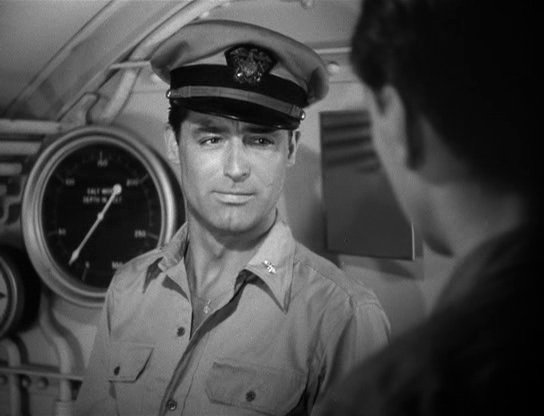
Cary Grant in Destination Tokyo (1943)
Destination Tokyo
The actual raid is not shown in this 1943 film starring Cary Grant, nor does Doolittle appear. It's an exciting submarine movie, though, about a crew tasked with infiltrating the Japanese mainland to gather information vital to the first air strike against Japan.

See also:
Remembering D-Day, Hollywood-style
Remembering Pearl Harbor, Hollywood-style

Tuesday, December 7, 2010

Remembering Pearl Harbor, Hollywood-style

Commemorate today's anniversary with this list of films, offering Hollywood's take on the Before, During, and After of the attack on Pearl Harbor.

Before

Flying Tigers
John Wayne in his P-40
John Wayne leads the famous flyers — in this movie, a mixed bag of principled freedom fighters and hot-shot mercenaries — against the Japanese in pre-Pearl China. Motives and personalities may be disparate, but everyone pulls together after FDR's famous speech.


Donna Reed and Montgomery Clift
From Here to Eternity
Set in Hawaii in the weeks leading up to the attack, this classic features Burt Lancaster and Montgomery Clift as the toughest-but-most-vulnerable soldiers in the army. They love the service, and they want to be loved back. Is that so wrong?

During

Tora! Tora! Tora!
Sô Yamamura as Admiral Yamamoto
Both the Japanese and American sides are shown in this film from 1970. Much bickering about invasion strategy is shown on the Japanese side, while the Americans are shown repeatedly ignoring seemingly obvious clues about the attack. After all the destruction, the film attempts an uplifting ending with Japan's Admiral Yamamoto declaring, "I fear all we have done is to awaken a sleeping giant and fill him with a terrible resolve."

The attack begins
Pearl Harbor
Every line of dialog in this Michael Bay-directed film sounds like a paraphrased chapter of a history book ("All we have to worry about here is sabotage, so we've bunched our planes together to make them easier to protect.") or a parody of romantic clichés ("I'm gonna give Danny my whole heart, but I don't think I'll ever look at another sunset without thinking of you."). It's a paint-by-numbers period melodrama whose colors drip all over the CGI-enhanced fantasy of actual events, though if you can sit through the first hour and a half you will eventually see Pearl Harbor blown up Bay-style, which I guess is something.

After

Thirty Seconds Over Tokyo
Spencer Tracy as James Doolittle
Spencer Tracy makes sporadic appearances as James Doolittle, the mastermind behind America's retaliatory air strike at Japan. The real focus is on the other flyers, namely a bomber crew led by Van Johnson's Ted Lawson. While the men succeed in hitting their target, they don't fare as well afterwards when their plane crash-lands in Japanese-occupied China.

1941
Slim Pickens
Dare I profane the solemn day by recalling Slim Pickens, prisoner on a Japanese submarine, simulating defecation by dropping his boot into a toilet in order to prevent a Cracker Jacks compass from falling into enemy hands? I dare!

See also:
Remembering D-Day, Hollywood-style
Remembering the Doolittle Raid, Hollywood-style

Friday, November 5, 2010

Life or limb

James Franco in 127 Hours
With the opening today of 127 Hours, a movie based on the true-life story of mountain climber Aron Ralston, who cut off his right forearm to free himself from a stuck boulder, audiences will be treated to a purportedly faint-inducingly graphic amputation scene. To commemorate this occasion, I present three similarly hard-to-watch scenes from other films. None have the graphic reputation of 127 Hours, though they are all painfully uncomfortable just the same.

Lifeboat

Alfred Hitchcock's Lifeboat (1944) forces a socially diverse collection of passengers into the tight confines of a lifeboat after their ship is sunk by a German submarine during the Second World War. The situation becomes further uncomfortable when a German sailor from the U-boat, which was also sunk in the battle, is pulled on board. Swearing he is not the officer who ordered the attack, the German is spared execution, though as the film goes on suspicion about the man increases. When one of the passengers' legs becomes gangrenous, the German convinces the others that it should be amputated — and that the he should perform the operation. Ill-equipped for such a procedure, the other passengers can offer the man only a few sips of alcohol as anesthetic before his leg is cut off with a knife. Adding to the discomfort is an irksome suspicion that the German is acting not because he truly believes the amputation is necessary, but in order to literally chip away at the enemy.

Thirty Seconds Over Tokyo

1944 was a banner year for cinematic limb-cutting, with Lifeboat followed by another film set during World War Two, Thirty Seconds Over Tokyo. During the famous Doolittle Raid of 1942, Lieutenant Ted Lawson and his crew are forced to crash their plane in occupied China after flying a bombing mission over Japan. Aided by sympathetic Chinese, the men are helped to a nearby town, where doctors agree that Ted's left leg needs to be removed. Ted is given a spinal injection, which he is told will numb feeling below the waist, but leave him conscious during the operation. But when the doctor starts cutting, Ted begins to regain feeling, first in his toes, then in his ankle. As he screams for the doctor to hurry, he falls into hallucination. Inside a cabin at winter time, a cheerful and intact Ted tells his wife over the phone that he's calling from a lumber camp, everything is fine, but he had to make an unexpected landing. He asks her about Christmas preparations and to describe the presents under the tree. Through the window in back of Ted, two men can be seen using a large saw to cut down a tall tree. As Ted banters happily with his wife, the men keep sawing, quickly, steadily, cutting further and further into the trunk. The tree falls, and a startled Ted turns to see it hit the ground just as he comes to in the Chinese hospital...

Mad Max


One of the most disturbing amputation scenes doesn't even depict an amputation. In the grim future of Mad Max (1979), Max Rockatansky is a vengeful cop tracking down and killing members of a gang who murdered his wife and infant son. He finds the last surviving thug on a rural stretch of road near an overturned car. Max handcuffs the man by the ankle to the wrecked vehicle, which is leaking gas profusely. He then rigs the car to eventually explode by positioning a flaming cigarette lighter near the fuel leak. Max picks up a hack saw and tells the hysterical criminal, "The chain in those handcuffs is high-tensile steel. It'd take you ten minutes to hack through it with this. Now, if you're lucky, you could hack through your ankle in five minutes." He drops the saw next to the man and walks to his car. As Max drives away, we see an explosion through his rear window. Though we never know what choice the handcuffed man makes, we are left contemplating his horrific options, the image of the hack saw still in our minds.