###
One of the challenges of adapting
Henry V to film lies in reconciling Shakespeare's Chorus with the seemingly limitless capabilities of film. The Chorus appears repeatedly, outside the "diegesis," or "world of the film's story," to remind the audience that what is being presented is only a feeble imitation of the actual historical events — due, apparently, to the shortcomings of the current players and of theater itself — and to practically apologize for the current production's inability to faithfully depict those events. Film, however, is capable of showing virtually anything, and showing it in a way that its audience will accept as "realistic." The filmmaker, then, needs to find a way to keep the Chorus' claims, explanations, and apologies from contradicting what is shown on screen. The filmmakers responsible for the two most reknowned attempts at this filmic conversion — Laurence Olivier and Kenneth Branagh — succeed in doing so, though each in a different way:
- Olivier spreads the artifice of the stage across the unlimited expanse of film
- Branagh confines film's ability for realism to the small space of the stage
Olivier's Method
 |
| The Chorus on stage |
Olivier's film opens in a way that perfectly contains the Chorus' claims and keeps its lines entirely relevant. By presenting the Prologue and the first several scenes as a stage production in the year 1600, the Chorus' lines are entirely appropriate: the Chorus is not begging the pardon of the film audience, but of the stage audience being depicted on film. The Chorus appears as just another actor on the stage of the Globe Theater, and because of the relative simplicity of the stage we are shown, the Chorus' lines seem natural and justified — there is no way that small stage could ever hold the "vasty fields of France."
 |
Harfleur: Removed from the stage,
but not from the artifice |
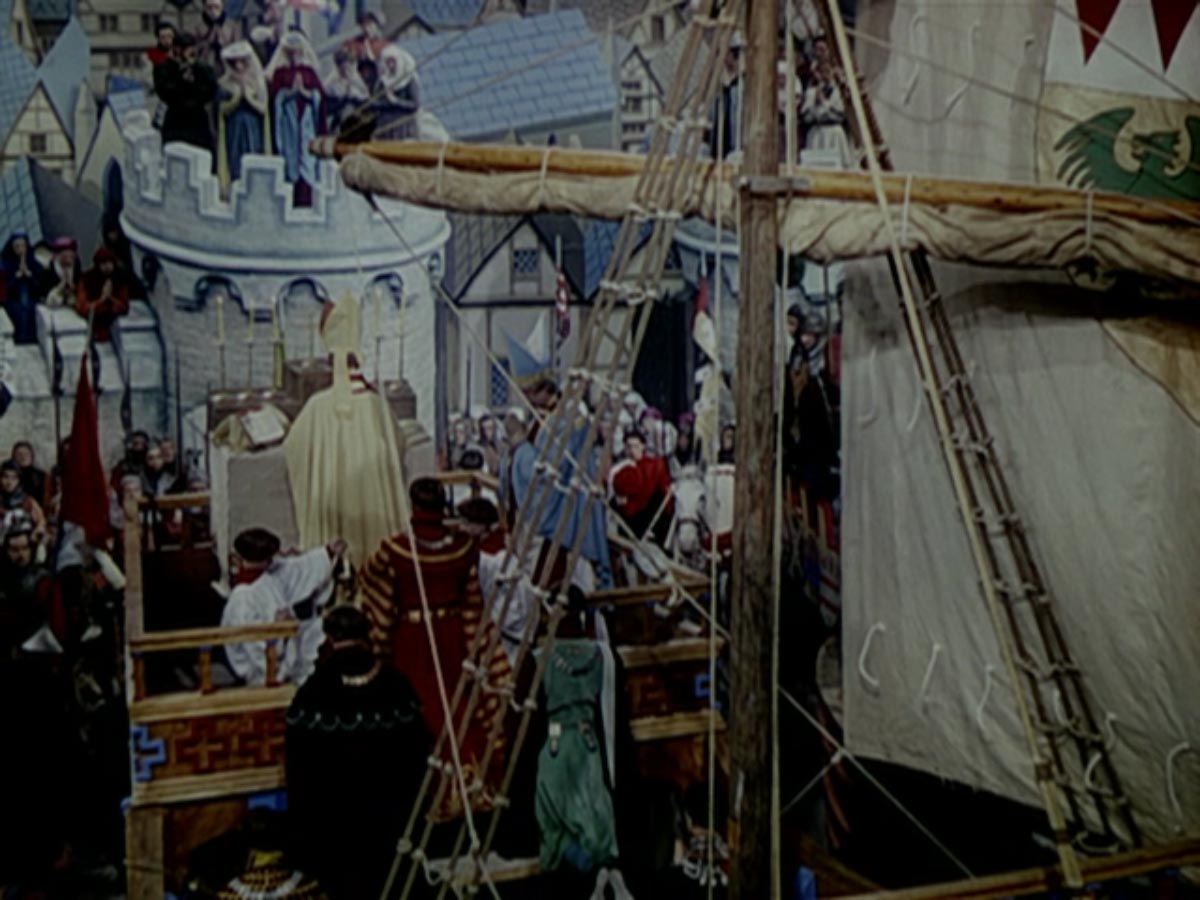
This opening allows us to gradually and comfortably accept the notion of the Chorus in the film — we are watching a filmed stage play, and the Chorus' comments correspond with our expectations of what can be shown on the filmed stage. As Olivier leads his film off stage, however, he must compensate for the loss of those elements which previously gave his Chorus immediate relevance — the physical stage, the theater's interior, the reacting audience — and he does so by spreading the artifice of that stage across the larger filmic environment he subsequently presents. By taking his play/film off of the stage, Olivier frees it of the stage's spatial confines and begins to show the larger expanses that film can more easily present, but at the same time keeps everything in those spaces looking artificial, stage-like. Perspective is skewed; clothing is very colorful and ornate, more like costume than wardrobe; the acting style remains similar to the style of the stage play just previously demonstrated. All of these things appear in front of painted backdrops which, though they imply greater depth than the small stage of the theater, are obviously painted, artificial. Though we have left the Globe, the most obvious reminder of the play's existence as a play, we are bombarded with a very pronounced theatrical artifice.
Even when Olivier repeals the artifice of the painted backdrops to show us a natural landscape, he dresses that landscape with much of the same artifice he uses on his sound stages — fancy costumes and banners, colorful and theatrical sets — or he obscures it with fog, preventing its clear recognition as something familiar or real. These natural landscape shots are also often intercut with shots of the same landscape noticeably recreated in miniature. Other times deep-perspetive live action is presented before a very artificial landscape backdrop, combining the artificial depth of the painted set with the natural depth of field the camera can achieve.
 |
The French attack the boys
and the luggage |
This method allows Olivier to fill his screen with much of what the Chorus tells us can not be shown — the vast battlefield, the huge armies fighting, the horses, the lavish costumes. He can show us these things because he keeps them looking artificial and imaginary: he follows the Chorus' instruction to imagine that which can not be shown on stage and projects for us one possible imagining of Shakespeare's play, an imagining directed by the Chorus on stage at the Globe Theater in 1600. Therefore, it is not the case of Olivier making concessions in order to keep the Chorus relevant to his screen adaptation, but of the Chorus guiding Olivier's production in the same way it would guide an audience member's imagination at the Globe.
 |
| "On your imaginary forces work" |
Realizing this, it becomes apparent why so many of the Chorus' directives are included in Olivier's adaptation: "Linger your patience on," "Still be kind / And eke out our performance with your mind," "Suppose that you have seen," "Play upon your fancies." It also becomes apparent why such emphasis is given to the first instance of these directives, during the Prologue: As the Chorus address the audience at the Globe, there is a long pause after the line "That did afright the air at Agincourt," during which the Chorus walks to the front of the stage and looks right into the camera in medium close-up (at the audience in the theater sitting right in front of him, perhaps, but most definitely at us, the film audience) before continuing with "On your imaginary forces work."
Branagh's Method
 |
| Branagh's Chorus behind the scenes |
Branagh begins his film in a "behind the scenes" fashion similar to some of the early moments of Olivier's version, but where Olivier shows us the backstage preparations of stage players, Branagh takes us behind a movie set to a space cluttered with the trappings of film production. He presents the Prologue among assorted props and light riggings in a scene that instantly confirms the Chorus' claims of artifice — from this vantage point, we can see that what we are being shown is all artificial, or "just a movie."
What follows, though, starting in the following scene (1.1) and continuing throughout the film, appears anything but artifical. The acting, costumes, and sets all seem to match what an audience of the late 20th century would consider "realistic," or acurate for the period depicted. Branagh shows us much of what Shakespeare's Chorus asks us to imagine or to supplement with our minds — horses, kings dressed in authentic costumes, the seige of Harfleur. He does so, however, in a way which ulitimately keeps the Chorus relevant. Branagh's method centers on his presentation of space.
 |
Branagh's Eastsheap: Tight framings
in small spaces |
Branagh imposes spatial limitations on his film by confining the action within small spaces. In doing so, he conceals from us the larger expanses of Henry's surroundings and references a larger world, a world accessible to the characters on screen but witheld from us. Much of the film is shot in tight framings, with scenes unfolding in a series of close-ups or medium shots, without an all-encompassing establishing long shot of the characters' environment. Interiors are shot in small rooms, confined spaces which suggest the characters' larger environments but do not actually show them. The Eastcheap scenes, for example, show us only one room of the boarding house. Characters enter from and exit to other rooms (a couple of extras walk into other rooms before Bardolph's first line, Pistol and Nell enter from an adjoining room, Nell goes upstairs to check on Falstaff, the men go downstairs when departing for France), but the camera remains in the main room, never allowing us to move throughout the larger space implied by the mobile characters.
 |
In little room confining mighty men:
The trap at Southampton |
The apprehension of the traitors is another example. The walls and the ceiling of the room at Southampton are shown to emphasize this restricted space and to emphasize a feeling of entrapment — the traitors set a trap for Henry, but walk into one themselves. Branagh and cinematographer Kenneth MacMillan keep the focus shallow and the framings tight. The deepest shot in this scene is the first one, which looks across the room at the three traitors. Even then, though, our view is obstructed at first by the woodwork in front of the camera, reducing the sense of uninterrupted visual access to large spaces.
 |
The introduction of the traitors:
rising land and a white sky
obstruct a view of the horizon |
Even when Branagh ventures out into open, natural spaces, he confines them with relatively tight framings. Never is there an extreme long shot showing the French countryside, not even during the most significant outdoor scene, the Battle of Agincourt. The closest Branagh comes to revealing a vast outdoor landscape is at Southampton, as the Chorus introduces the traitors. Even here, however, Branagh fills his background with a grassy cliff rising behind the Chorus, concealing from us the infinite depth possible as perspective fades into the horizon.
 |
Henry passes the Archbishop's
antechamber: a larger space
is implied with shadow. |
Essential to Branagh's spatial restriction is his lighting. Many shots are darkly lit, so that hidden from our view is not only the space beyond the frame, but the space immediately surrounding the characters in the frame. The first scene after the prologue is a good example — the Archbishop and Ely are kept in tight framings, engulfed in darkness. We see very little of their surroundings, just the door the archbishop closes behind him and the faint glimpse of one of the antechamber's walls. When the Archbishop peers out the door to see Henry walk by, escorted by his guard, we do not see Henry or the guards except in shadow. By showing only a brick wall, one prop (a candelabra), and the shadows of a pillar and five walking figures, Branagh implies a larger area — a pllar-lined hallway leading to Henry's presence chamber.
 |
| Henry's presence chamber |
Even when surroundings are shown, the sets are relatively plain. Unlike Olivier, whose sets, though artificial-looking, are nonetheless very ornate and complex, Branagh keeps his sets relatively sparse. Many, whether they are darkly lit or not, are simple despite their apparent realism. Henry's presence chamber, in which he hears the argument presented by the Archbishop concerning Salic law, contains his chair, the chairs of the lords and nobles, and a few candlesticks. The rest of the room is concealed by darkness and by the selective presentation of Branagh's camera. The equivalent French room, while more brightly lit, gets the same selective treatment — we never see a long establishing shot of the entire room, just close-ups and medium shots of the speaking characters in it. Once again, there is little in the way of a set featured — there is a set, of course, but because we are shown so little of it, it does not need to be large and eloborate.
This strategy of presenting sparse sets in tight framings, of witholding from our view the "complete picture" of Henry's surroundings, allows Branagh to present his film with great economy, but also to create a sense that something is missing, which is just what the Chorus claims to be the case. Furthermore, this method adheres to the spatial restrictions imposed on the production by the Chorus in the Prologue. The Chorus and its claims, therefore, do not contradict what is shown on screen. This method is most effective during Branagh's depiction of Agincourt, where it assumes thematic significance, and where it does something more important than keep the Chorus relevant to Branagh's film — it keeps the film relevant to Shakespeare's Chorus.
Branagh's Agincourt
Perhaps the most striking element of Branagh's adaptation is his battle of Agincourt, which certainly runs counter to the low expectations set by the Chorus — it is graphic, violent, dirty, and bloody. There is little need during the battle to compensate with our imaginations for a lacking sense of "realism." Nonetheless, Branagh's method is still at work, imposing the same spatial restrictions on the battle as it does on the rest of the film. (Upon recent watching, I noticed a certain "theatricality" to Branagh's "realism" which I may write about in the future. For now, suffice it to say that for all immediate purposes, the film presents a much more graphic depiction of the battle than Olivier's.)
 |
| York is killed by the French |
 |
| Pistol finds Nym dead |
 |
| The boys, murdered by the French |
 |
Williams watches as the
French forces charge |
Branagh withholds from our view the larger space of the battlefield by shooting most of the action in medium to close framing. As the English await the charging French, for example, we see close-ups of their faces, never an extra wide shot of the entire army. Nor do we see the French army charge en masse as we do in Olivier's film — instead we are shown only the key speaking characters (the Constable, the Dauphin, Orleans, Montjoy) in a medium shot right before their charge, then more close-ups of the English faces who see the charge denied to our view. The suspense and tension we feel for the imminent clash is created by the looks on the faces of the English and the off-screen sound of beating hoofs growing progressively louder. The subsequent fighting is also shown in tight framing: even as York is bloodily skewered in slow motion, we have very little sense of his greater surroundings.
 |
Band of brothers:
A large army implied
by shots of smaller groups |
Instead of showing the two large armies with hundreds of extras in sweeping long shots as Olivier does, Branagh implies greater numbers through multiple close-ups of familiar characters. The above-mentioned charge of the French is one example, as is the St. Crispin's Day speech. During Henry's pep talk only a relative few of the English soldiers are shown in the same frame as the king. A greater number is referenced, however, by Henry's offscreen looks and by shots of the individual soldiers responding to Henry's words. By using medium shots of the previously-introduced speaking characters (Macmorris, Nym, Exeter, etc.) with a handful of extras behind them, Branagh is able not only to imply a large army without the use of long shots crammed with extras, but also to adhere to another of the Chorus' directives, one which Branagh edits from his Prologue but could just as well have been left in place: "Into a thousand parts divide one man." Granted, Branagh's actors do not double up on roles, but their repeated presentation in close-up creates an effect similar to one long shot filled with many characters.
Still, while Branagh's spatial strategy creates a formal "lack" in accordance with the Chorus' disclaimers, the graphic nature of the fighting seems to violently contradict them. This contradiction seems further complicated by Branagh's editing of the fourth Chorus, although unlike the above-mentioned line ("Into a thousand parts divide one man") which was excised though it seemed relevant, in this case Branagh includes five lines which seem to greatly contradict the subsequent realism shown on screen:
And so our scene must to the battle fly;
Where — O for pity! — we shall much disgrace
With four or five most vile and ragged foils,
Right ill-disposed, in brawl ridiculous,
The name of Agincourt.
 |
"And so our scene must
to the battle fly..." |
Not only are these lines not removed, but they are displaced from the top of act four to the moment just before the French charge and the bloody battle begins. This displacement, as elsewhere in Branagh's adaptation, gives the Chorus' exposition — and its reminders of artifice — immediate significance. We are told, it would seem, right before the battle begins, that what we are about to see is but a feeble and artificial imitation of the actual event, though what follows does not appear so.
Why, then, would Branagh not only include these lines, but place them so close to the action they seem to contradict? The answer is derived both from Branagh's innovation and ideas Shakespeare included in his play four hundred years ago, ideas absent from the wartime film Olivier made. To see it, we must jump ahead to Shakespeare's Epilogue, which is edited substantially in Olivier's film but which Branagh keeps intact. It reminds us, after the exhilarating St. Crispin's Day speech, after the agonizing victory at Agincourt, after the lighthearted courtship of Katherine, that under the reign of Henry VI, the son and successor to Henry V, England would lose the land won by Harry and his "band of brothers":
Henry the Sixth, in infant bands crown'd king
Of France and England, did this king succeed;
Whose state so many had the managing,
That they lost France, and made his England bleed:
Which oft our stage hath shown; and for their sake,
In your fair minds let this acceptance take.
 |
"In your fair minds
let this acceptance take." |
The last line — the Chorus' last instruction — bids us to accept a historical fact which more than somewhat deflates the victory just depicted. Now it becomes clear why Branagh included the lines from the fourth Chorus. The mention of the "four or five most vile and ragged foils" is not meant to imply that the subsequent filmed battle will look artificial, but rather that no depiction of war, no matter how seemingly "realistic," can convey its true horror. Likewise, the "brawl ridiculous" does not refer to the feeble imitation of battle shown on stage or screen, but to war itself: it is often pointless and fought in vain. Branagh uses his filmic realism to graphically enhance Shakespeare's ideas about the nature of war.*
*Or at least this war. Shakespeare may have intended the comment to apply specifically to Agincourt and to the redemption Henry's victory seemed to give his lineage (see Henry's prayer in 4.1). However, Branagh's film makes these ideas applicable to any time. (One of my college professors described hearing some of the audience cry during the St. Crispin's Day speech when he saw the film during the early days of the first Gulf War.)
A Chorus' Lines: Appendices
I. Branagh's Other Methods
While Branagh's cinematic techniques are perhaps the most impressive elements of his strategy to keep the Chorus relevant, they are not the only methods he uses. Most noticeable is his editing of Shakespeare's text. Whole scenes are removed, as are certain characters, their lines eliminated or abbreviated and given to others. The Chorus' lines fall victim to this same treatment.
Several — but significantly not all — of the Chorus' disclaimers are removed entriely. Gone from the Branagh's prologue, for example, are the instructions to imagine horses "Printing their proud hoofs i'th'receiving earth," to allow one actor to play several parts, or to "make imaginary puissance." By removing such directives, Branagh is free to show us horses, for example, without running counter to the expectations set by the Chorus.
The Chorus' appearances are also segmented and displaced throughout the film, instead of occuring only at the beginning of each act, where they were placed by Shakespeare. The Chorus at the top of Act 2, for example, first explains how the able men of England are eager to follow Henry to France, then tells us of the three traitors and their plan to kill Henry in Shouthampton. Scene 1, however, is set in the boarding house in Eastcheap, removed from Southampton, and not related to the just-mentioned conspiracy. Branagh, instead of presenting the complete Chorus at the begining of the act, divides this Chorus into two parts, and places each part immediately before the action it describes. Therefore the mention of the men excited to find fortune in France is followed by the scene at Eastcheap, and the exposition about the traitors immediately precedes Scene 2, when Henry confronts those conspirators. This helps keep the Chorus and its function as scene-setter important on a scene-to-scene, rather than act-to-act, basis and the Chorus' lines more relevant to the immediate action on screen.
Still, Branagh doesn't remove the Chorus entirely. He leaves in enough of the Chorus' apologies to give the impression that something is lacking, so his film must therefore reflect that lack.
(Olivier also edits the play substantially. Indeed, he rearranges scenes and segments the Chorus' lines much more than Branagh does. Because his method is based upon the Chorus' instructions to imagine, however, Olivier's edited text still maintains these instructions and disclaimers. His elimination of other lines, scenes, and characters has less to do with keeping the Chorus relevant and more to do, it would seem, with time restrictions, clarifying language for a modern audience, and with making a pro-English statement during World War II [see Appendix IV for more on this].)
II. Branagh and the Muse of Arc Light
 |
| The Chorus shouts "our play!" |
What struck me the most about Branagh's Prologue was the way the Chorus loudly (angrily?) shouts the last two words of the Prologue — "our play!" — in noticeable contrast to his more subdued presentation of the previous lines, as he throws open the doors which lead, presumably, to some part of the on-camera set, with great and sudden energy. This burst of energy and what sounded to me like frustration or anger seemed very sudden, certainly unexpected.
In reexamining this scene later, a few things caught my attention. One was the "behind the scenes" setting in general, which is similar to that of some of the early shots in Olivier's film. But while Olivier's behind-the-scenes shots were of the backstage of a theater production, Branagh's are behind the scenes of a movie set. Like Olivier's backstage moments, which establish that what is about to be shown is a play, not an attempt to reproduce reality, Branagh's backstage Prologue references the fact that his production is produced and manufactured, too.
 |
| "O for a Muse of fire..." |
The Chorus delivers the Prologue while wandering among the trappings of film production — extra props, large lighting rigs, plywood sets. The fact that implements of lighting are very prominent among these trappings also caught my attention: the large lighting rigs, certainly, but also the various large candlesticks which not only decorate the sets we are soon to see, but provide the lighting (at least the diegetic lighting) so vital to Branagh's method. This juxtaposition of fire light and electric light recalls the very opening seconds of the film, where the Chorus, after making the first shot appear from the darkness by striking a match, throws a switch that fills the sound stage with the light and electric hum of the overhead rigging. I am almost certain he then gives a certain knowing look to the camera, perhaps a subtle comment on the light overhead, as if he realizes something about it that he expects us to realize as well.
 |
| The Chorus looks at the camera after throwing the switch. |
 |
The Chorus walks past electric lights... |
 |
...and then past candles. |
This look, and the exclamation that follows, frame the Prologue and its instructions to imagine that which can not be shown. They give the impression that the Chorus is frustrated, as if he knows that his match — his "muse of fire" — is meager power compared to that of the lights above, to the power of film. He may also realize that his place as expositor is very precarious in the film — as he throws the electrical switch he sees that film with its electric light has the ability to show everything, while he and his fire have the ability to show only a relative little. Branagh allows his Chorus to make the demonstration of the great power of electric light, though I suspect the Chorus is aware that the true control of that light rests with the filmmaker, and that he is given only a token role, maintained merely by the filmmaker's wishes. (Another image occurred to me upon re-watching, that of the Chorus as an employee caught in a corporate takeover of stage by screen, an employee who must adapt to the latter to survive, regardless of his disdain for it.)
It could be, though, that the Chorus realizes the limitations of film itself, and is frustrated that even film, with all its ability, with its power of arc light — a light brighter than the light of fire shown by the match and subsequent candles — can be revealed as artifice. Throwing the light switch reveals the implements of film production, exposes the film as unreal, and shows that with too much light, the fantasy is betrayed (imagine the overhead lights in a movie theater being turned on in the middle of a screening). It reminds us that despite any cinematic realism that may follow, this, too, is not real, and therefore not as spectacular as the actual events depicted.
III. Olivier's Visual Reference
 |
Olivier's Harfleur
|
If we accept that Olivier's film is the projected imagination of the audience he depicts at the Globe Theater in 1600, then the artificial sets and backdrops are not just devices used to keep the Chorus' lines relevant, but elements of that audience's imagined vision. Olivier's artifice-rich mise-en-scene, which recalls the perspective and composition of 15th century painting, seems to be based on the assumption that an audience of 1600 would have no other visual reference of Henry's time than the artwork produced in it. Therefore, the imagination of Olivier's depicted audience is based greatly on paintings made in Henry's time.
Granted, all of this is filtered through the perceptions of much later decades. I thought this way in the year 2000 (when this essay was first written) about a film made in 1944 about how an audience in 1600 would imagine the early 1400's. Therefore, putting an exact range of dates on a certain group of paintings is perhaps unnecessary: as we recognize that much of Olivier's film reflects a 1944 perception of Shakespeare's time, we must also allow that an audience in 1600 would have its own perceptions of Henry's time, and that perception could be influenced by a general style of painting without strict attention to dates. (To be really technical, it is likely that many of the groundlings at the Globe would not have had access to such paintings...)
It is also interesting that the natural landscape is used in Olivier's film, primarily at the field at Agincourt, perhaps because a large empty field would look the same to people in 1400, 1600, and 1944. Olivier's shots of the battlefield, then, are set in nature — a nature common to people throughout time and therefore able to be recalled and imagained by people throughout time — but the non-natural elements which furnish that landscape — the horses' and soldiers' costuming, the banners, tents, castles, etc. — are part of the imagined vision which references the artwork of an earlier time.
When I set out to find (via internet search, using keywords like "15th century painting," etc.) specific works to illustrate my thoughts on Olivier's visual reference, I eventually came across a group of paintings from
Les Tres Riches Heures du Duc de Berry, a "book of hours" painted in the early 15th century by the Limbourg brothers. These paintings not only show the stylistic elements I saw recreated in Olivier's film (the earlier form of perspective, the arrangement of people in clusters, etc.), but seem to provide an actual blueprint for certain of Olivier's scenes.
I later learned that
Les Tres Riches Heures was used as reference and inspiration during the making of the film, though I was unaware of this when I was looking for examples (though once I found
Les Tres Riches Heures, I made the assumption that it must have been consulted). I mention this not to tout my powers of observation, but in support of
my belief that while all "meaning" rests with the viewer, filmic communication is not entirely random: in many instances a filmmaker's "intentions" can be communicated succesfully, even when they are not entirely superficial.
Example 1
 | | Henry before the gates of Harfleur |
 | The French king and his lords at the table
|
|
 | | "January" from Les Tres Riches Heures du Duc de Berry, painted by the Limbourg brothers, c. 1412 - 1416 |
|
The French soldiers positioned on the upper right portion of Olivier's Harfleur gate are arranged in a similar clustered fashion as those in the top of the
January painting. The view of the table at which the French king and his lords sit simulates the method of perspective used in the painting — we see more of the tabletop (which is tilted forward on Olivier's set) than we should for a relatively straight-on side view.
Example 2
|
|
 | | "February" from Les Tres Riches Heures du Duc de Berry, painted by the Limbourg brothers, c. 1412 - 1416 |
|
The three frames at left, from the shots preceding 5.1, suggest a composite version of the
February painting. The top frame shows the snow-covered hills and the distant village, seen in the top left of the Limbourgs' painting, the center frame shows a faithful re-creation of the open-sided hut and other of the painting's barnyard elements, and the bottom frame echoes the capped mule-driver at the top of the painting in the form of the capped man walking behind Fluellen and Gower.
IV. Olivier's Henry V and Eisenstein's Alexander Nevsky
 |
Alexander Nevsky (1938)
|
I first watched Olivier's
Henry V shortly after having seen
Alexander Nevsky for the first time. I noticed during the battle of Agincourt several shots which strongly echoed certain shots from Eisenstein's battle on frozen Lake Chudskoe, which got me thinking about how Olivier's film originally functioned in a way that Eisenstein's did — as political propaganda. I'm assuming much has already been written on the role of Olivier's film as World War II Allied propaganda (or pep talk, at least), and I'm not going to attempt any in-depth examination here. What follows is a brief overview, anyway.
Eisenstein's
Alexander Nevsky was made in 1938, six years before Olivier's
Henry V, and is based upon an actual victory won by a relatively small army of Russian soldiers, led by Nevsky, over invading Germanic forces in 1242. As in
Henry V, this small army is led against a seemingly overwhelming force by a well-loved leader and eventually triumphs in a climactic battle. Eisenstein's anti-Axis message is quite clear, as his film pits Nevsky's Russians against actual Germans, while Olivier's suggestion is only a little less direct, with the English fighting for control of France, which was held for a time during World War II by the Nazis.
In an attempt perhaps to rally Allied sentiment, Olivier eliminated from his film many of the more savage and warlike tendencies Shakespeare attributed to Henry. Henry's threatening at the gates of Harfleur is gone — only Nazis, after all, could have been associated with the atrocities Henry claims his troops would commit should the town not surrender — as is his order to kill all prisoners during the battle of Agincourt (Branagh also eliminates this command, though keeps much of the graphic Harfleur threatening intact). The discovery of the three traitors in Act 2 is banished from Olivier's film, as is the mention of Bardolph's hanging, perhaps to spare Olivier's Henry from having to give any direct order to kill, especially an order to kill Englishmen.
The pivotal moment in Eisenstein's battle on the ice occurs when Alexander challenges the Germanic leader to one-on-one combat on horseback. Alexander is successful in toppling the German from his horse with a blow to the face, and the battle is subsequently won by the Russian army. Olivier's Agincourt contains a similar moment, when Henry, angered by the murder of the boys, rides to challenge the Constable of France and knocks him off his horse in similar fashion. This sequence borrows from Eisenstein's duel quite directly, as do other moments of Olivier's Agincourt from other moments of Eisenstein's ice battle. Even William Walton's musical score for Olivier's Agincourt echoes at times Prokofiev's music for Eisenstein's clash on the ice.
While I'm not prepared at the moment to examine this relationship in any more detail (nor to extend it to include Branagh, though the comparison of Branagh's and Olivier's methods tempts a hasty comparison with Eisenstein's early and later works — the montage of the early films implying larger space through the quick editing of various close-ups [Branagh?], the slower style of the later films presenting vast landscapes and armies in much wider framings and longer takes [Olivier?]), I have provided stills to illustrate the similarities.
| Henry V (1944) |
Alexander Nevsky (1938) |
|
|
|
|
|
|
|
|
|
|
|
|
|
|
|
|
|
|
V. Olivier's Lesson
 |
| Olivier's Henry at Southampton |
Olivier's visual style also provides a certain amount of instruction about film itself, particularly about our expectations of how film communicates. All film does this, as do all forms of communication — a poem, for example, by its very form is always "about" not only its "subject" (a perfect rose, a Grecian urn, a dying mining town) but itself, its formation and existence as verse. We can look at a given form of communication and discern not only its "message," but also something of how that message was communicated to us. Often the "message" dominates the event, and we notice it more than how it was actually communicated. When we watch a TV news story about an apparent injustice perpetrated by a large corporation, for example, our shock and anger about the reported atrocity often overshadow how that atrocity was reported, how the shooting and editing of the footage contributed to our emotional reaction.
Like the TV news, movies are often constructed in a way which conceals the fact that they are made to manipulate an audience in order to provoke a certain response. Sometimes we become aware that certain mechanisms are at work, like when we predict the way a plot will unfold after having seen the same plot in countless other movies. Other times the mechanism at work is less obvious, but plays upon our noticeable anticipation, as when a character looks off screen in surprise and we expect to have the cause of that character's surprise revealed to us in the next shot, which we also expect will come quickly. When we don't get what we expect from film, we know it, though often our disappointment fails to become realization — realization of why we are disappointed, of what the film did to provoke our response.
Some filmmakers deliberately play against our expectations in order to expose the mechanisms behind the film. One of my first breakthrough realizations about how film "works" came to me after watching Godard's
Weekend — in the middle of ranting to a friend about the ridiculously long, boring, and pointless French film I was made to watch in class it occurred to me that I had probably responded just as the filmmaker predicted I would, the way he was depending on me to respond, all because of the ways he violated everything I had come to expect from traditional narrative movie-making.
Olivier's
Henry V, while perhaps not as radically instructive as
Weekend, had a similar effect on me. I had a hard time being drawn into it at first, and to this day do not have the same connection with it as I do with Branagh's film. This has to do with the almost ever-present artifice of Olivier's visual style. The skewed perspective of the sets, the artificial backdrops, the theatrical acting style — all kept me aware that I was watching something unreal, constructed. I was able to become more involved with the film the more the artifice was repealed, so by the time the English were jumping out of trees onto the French soldiers at Agincourt, in an actual outdoor location, the film seemed to me as natural as
The Adventures of Robin Hood with Errol Flynn, which, granted, is only "natural" in a very stylized way. This apex was too long coming, though, and too quickly replaced, it seemed, by the return to the distorted sets of the French palace, and shortly thereafter to the inside of the Globe Theater.
Along with playing upon expectations of how a film should hold our attention — even a Shakespeare film, which must always deal with the problem of Shakespeare's language, which anchors the film to something not only outdated (the various words and references no longer in common use), but stylized (put into verse), despite any other apparent realism — Olivier's adaptation also traces the experience of watching movies in a theater, or perhaps even plays on a stage: First, the entry into the theater, as depicted in Olivier's opening scene as we are taken into the Globe. Then the detachment we feel from the film as it first starts and we settle into our seats and wait for the noisy folks around us to quiet down and do the same, as the spectators in Olivier's Globe do. A gradually increasing involvement follows — some might call it a "suturing" — which Olivier demonstrates by gradually removing layers of artifice as his play leaves the stage. The highest point of audience involvement follows, represented by Olivier's Agincourt, the point of the film we've most been waiting for, the event that everything has been building up to and upon which all narrative resolution depends, shown outside, away from the artifice of the indoor sets, engrossing. Then, a mild detachment, the anticlimax of the resolution — shown as Olivier's film becomes artificial again, now inside the French palace, and the action, the casual wooing of Katherine, less engrossing than and certainly anticlimactic to the previous battle. Finally, the abrupt disruption, the eviction from the fantasy as the movie ends (perhaps augmented by an impossibly "happy" ending which makes us question the reality we have been shown up to this point), the credits roll, the lights come on in the theater, which Olivier shows as the newly wed Henry and Katherine turn around and are revealed once again as actors at the Globe, wearing heavy make-up, facing and acknowledging the audience in the theater, which we now see once again, as we do when the lights come on in our (movie) theater.
VI. Stage vs. Screen: Henry V in the Park
Introduction
Several months prior to writing this essay I saw for the first time a stage production of
Henry V. It was a "Shakespeare in the park" type of thing, which was also new to me. I wondered prior to going if the outdoor production would be able to hold my attention, since I was much more accustomed to watching movies or an occasional indoor stage production where the atmosphere was almost cinematic — lights dimmed, audience siting in a darkened space away from the illuminated stage, the actors "in character" throughout, not acknowledging the audience in any way until curtain call. I wondered if the vast and less focused outdoor setting of this daytime production would be a distraction from the action on stage, and what it would be like to watch actual people — not the projected images of people — perform live a play which repeatedly addresses its audience, pointing out its own supposed weaknesses through the Chorus.
At that point, I had read Shakespeare's play once or twice, and had been re-reading it and working with it quite a bit to generate ideas for
A Chorus' Lines. The only performances of
Henry V that I had seen were the film adaptations by Olivier and Branagh. Watching Olivier's film had in many ways been to me like watching a stage production — I admit to having a more difficult time being drawn into it than into Branagh's version, and much of that, I think, has to do with Olivier's stage-like presentation.
This "stage-like" presentation had been the focus of much of my initial thoughts for
A Chorus' Lines, which I had been formulating slowly in the several years since college, where I had my first exposure to
Henry V and the two film adaptations in question. College was also my first exposure to psychoanalytic film theory and its notion of "suture," a complex phenomenon whose applicability depends (as does the applicability of all psychoanalytic theory) on how much credence you give to the psychology of Freud and Lacan (I have another essay which touches on this that I will post eventually). Briefly, "suture" is the process by which a film "sucks in" its spectators, envelops them within the world of the film and makes them believe that what they are seeing is, if not real, exactly what they would want to see. Every film, it would therefore seem, has the power to make itself desirable to everybody. This isn't in fact the case, however, and this discrepancy contributes to the debate over suture and psychoanalytic film theory in general. In any event, while I am undecided on some of the more detailed particulars of the suture theory, I do believe that film has a unique ability to connect with its audience in ways that the stage can not, and for me that connection has always been more profound than any with the stage.
I also believe in a saying told to me by one of my professors, though I forget to whom it was originally attributed — "Theater is the real attempting to become the unreal, while film is the unreal realized." That is, theater, while it depicts something imaginary, is still presented by physical beings who are subject to the same reality as their audience. Film, on the other hand, is pure fantasy: there are no physical performers — no physical
anything — present in the same space as the audience. All that exists within the projected beam of light is the unreal, the new imagined reality the film is presenting.
Stage
When we watch a play, we are constantly aware, to varying degrees, that we are in fact watching actual people in the same room pretending to be things they are not. Their shared goal is to present the make-believe, to defy reality and show us something that does not exist, but always they are anchored to the reality of the stage. Regardless of how profoundly the players' communication makes us believe in the
idea of the fantasy, it can not free itself from the physical world that we and the players both inhabit at the same time in the same place.
For example, while watching a play I have a constant anxiety (which varies in intensity each time and from moment to moment during the play, sometimes remaining a very subtle underlying feeling and sometimes becoming a more palpable sense of discomfort) that one of the actors may flub a line, fall off the stage, be heckled, or somehow suffer an intrusion of physical reality which calls attention to the fact that s/he is not Henry V, Willie Lohman, or Eliza Doolittle, but merely another person in the room who has taken on certain affectations not just for our mild amusement, but to fulfill our collective wish to be taken somewhere else, to deny reality and accept what is not true.
Always while watching a play there is the potential for awkwardness or embarrassment. If an actor makes a mistake, we can empathize with that actor's possible embarrassment, and we can also feel awkward that we have all been exposed — exposed as spectators who now have more to deny. We have been denying reality up until the mistake by accepting the idea that this actor is something other than just another person in the room. Now we must deny it again, deny it further as we try to overlook the mistake which calls attention to the entire charade.
Embarrassment and awkwardness are not the only "risks" of watching theater — the spectator also risks losing the privileged position of anonymous, detached viewer. The notion of "safe spectatorial distance" is more easily threatened in theater. If an actor were to fall off the stage, some in the audience might react out of real concern and rush to the aid of the fallen actor. Most, though, would be either too far from the stage to provide help or, more importantly and more likely, so overcome by the awkwardness of the situation that they would sit in their chairs and feel the pressure to help but also the desire not to — people just don't experience something like that enough to know what to do with confidence. They don't have enough prior experience to feel comfortable in further interrupting the ritual — in further calling attention to the denial — by getting out of their seats and becoming an attraction. By getting up and helping, they would become part of the ritual, the "show," and would no longer be anonymous spectators.
Many plays deliberately make the audience part of the show, in overt ways (making the space of the audience the space of the extended stage, having actors converse with audience members) and subtle ones (actors pausing to wait for audience applause or laughter to subside before continuing, a Chorus which looks and speaks directly to the audience without soliciting a reply). There is always some degree of interaction between the players and the audience due to the fact that the two inhabit the same space at the same time. This interaction, or perhaps more specifically the physical conditions which make it possible, coupled with the overall physical apparatus of theater — lights, costumes, curtains, sets pieces, etc. — allows for the ever-present possibility that physical reality will intrude upon the fantasy which the play is attempting to make real.
Screen
With film, on the other hand, there is no threat of physical intrusion because there is nothing physical upon which to intrude. There are no actors on stage in the same room. The "performers" are all part of the same intangible ray of light. They are shadows incapable of being addressed or disturbed. They won't make mistakes, because they've had countless takes to get everything right and only the "good" takes (those the filmmaker sees fit to include, for whatever reason) make it into the final film. If a blunder were presented on film, we would not feel embarrassment for that performer because s/he is not in the theater. We probably wouldn't even consider it a mistake, but part of the show — our knowledge of how movies are made assures us that this is all premeditated and perfected long before it is displayed to us. This is perhaps why there is more "heckling" in movies — talking during a movie may annoy others in the audience, but it won't cause an awkward moment with any actors or disturb any ritual being performed because it is not an actual interpersonal confrontation. In the movie theater, we are safe to be anonymous — in relation to the presented fantasy — no matter what.
Granted, there are some ways a film spectator can experience awkwardness. I've been in screenings where the focus was off, a general murmur confirmed that the rest of the audience realized this as well, though no one was immediately willing to get up and report the problem to theater personnel. People talking during movies is a distraction to many (myself included), and subsequent confrontation can be very awkward. These moments of awkwardness, however, do not influence the fantasy being projected onscreen. Even if the film strip breaks, the fantasy continues the moment the film is repaired and projection resumes. There may be physical intrusions upon the technology which delay the presentation of the fantasy, but there is nothing which betrays that fantasy.
There is also ritual in movie-going, but again this ritual is more one-sided than that of theater. The ritual of watching a movie involves gathering with others to watch a fantasy. The ritual of theater is gathering with other people to watch a fantasy being enacted by even more people, people who often must adjust their performance according to the reactions of the first group, the audience. There is no such interaction, though, between an audience and a projected film.
Henry V in the Park
The outdoor production of
Henry V was presented in an amphitheater-style venue in a downtown park. By the time had I arrived, there was no more seating available on the large marble steps set into the small hillside immediately across from the stage. I had to join the crowd seated on the grass higher up the hill, above the last row of stone steps. Immediately I could tell that this was going to be somewhat uncomfortable. I was worried about my legs falling asleep, and needed to keep shifting my weight to keep them from doing so and to stay as comfortable as possible.
From the height of my "seat," the small stage did not easily command my view. In back of the stage was the rest of the park, a cement and iron "riverwalk" type of thing which I have always found interesting to look at, and beyond that the tall buildings of the city. There were a number of people seated around me, some who had, like myself, come downtown just to watch the play. Others, judging by the way they were sprawled out on the lawn sleeping, appeared to be at the park for other reasons. People were leaving their spots on the grass and returning with carnival-style snacks, which they shared with their friends in a ritual which became for them more entertaining than that offered by the play. The sparsely decorated stage below was but one of many sights competing for my attention.
Eventually the actor portraying the Chorus appeared on stage and began the Prologue. He was hardly audible. At this point, I really thought about leaving. I could barely hear what the actor was saying, and I knew there were over two hours left to go on the uncomfortable lawn, straining to hear. Eventually a few people began shouting that they couldn't hear, and the actor, once he realized what they were shouting, left the stage. When he returned, he had a new lapel microphone which he tested by ad-libbing, "Technological problems, even in the 16th century!", which was met with applause and laughter. Such recoveries often are, because the audience feels a sort of relief when the inadvertent causes of its secret anxiety — the actors pretending to be something else, pretending not even to see the audience — reveal themselves as human, admit to the charade, admit that they know they are not these characters, and that they know we all know they — and we — are pretending.
He continued, "As I was saying, 'O for a muse of fire'," and rushed through the few lines he had spoken prior to replacing his microphone and began with an earnest delivery once he had caught up to the unsaid lines. Now I could hear, though the actors' voices would fade and grow louder mid-line if they turned their heads during delivery. The microphones picked up the noise of sporadic gusts of wind, so occasionaly an actor's lines were stifled even if s/he were talking right into the mic. The PA system was loud and often distorted the actors' voices. At times, the actors walked through the audience, not interacting with us but certainly being mindful that we were there so they wouldn't step on us, and delivered their lines to actors on stage. Our space became part of the play. The safe spectatorial distance had been violated.
(Olivier depicts these kinds of distractions in the opening scenes of his film. He shows us the physical apparatus by taking us backstage to see the actors' preparations. Then he shows us what can go wrong with that apparatus as the Archbishop of Canterbury's entrance in 1.2 is delayed not only by Shakespeare, but by the commotion backstage which prevents the actor's timely appearance. Later, the actors portraying Canterbury and Ely [not the film actors, but the actors they portray] have problems with their props during the explanation of Salic law. In 1.1, Ely is heckled after he says "We are blessed in the change," and rain begins to fall in the theater during Act 2.)
This was a process very different from that of film, though while I was always aware of my physical surroundings, sometimes distracted by them, and while I was not experiencing the same "suturing" effect that, say, Branagh's film adaptation has on me, I was still interested in how the performance was unfolding, and I was genuinely enjoying the experience. The "ritual-ness" of theater became very apparent. I was not concerned with being "transported" somewhere else, or with believing in the fantasy, in the "unreal." My enjoyment derived from witnessing the enactment of a text with which I was already familiar, and from seeing how this particular company would perform each familiar scene.
It also occurred to me, however, that had I not been so immediately familiar with the text of this enactment it may not have been as enjoyable. My wife, who was with me at the park and who had not read
Henry V since college, was distracted by the surroundings and did not have the same enjoyable experience. (She recently reminded me of two other distractions I had since forgotten — a wedding party posing for photos nearby and the seemingly constant air traffic overhead.) This is also a somewhat extreme example — not all theater is presented in this manner. Had this been an indoor presentation our response would no doubt be different. This is not to say that indoor productions are not ritualistic, but due to the physical nature of theater the experience will change as the physical environment of the play changes.
Final Thoughts
Henry V is a particularly interesting case because on stage or screen its Chorus addresses the audience directly, though in each situation the effect is different. Being in a darkened movie theater watching Derek Jacobi speak the Chorus' lines, even with him looking right into the camera, right "at us," is an entirely different thing than having a stage actor in the same room speaking the same lines. The stage actor, though s/he is reciting a pre-written script, is still addressing us directly, talking to us, acknowledging us as spectators to the ritual. The projected image of the film actor looking right into the camera is still just an image, not an actual person before us. It is not a cognizant entity capable of making the distinction between screen and spectator, so we are free to remain protected anonymous observers.